poetry.us.com

Today's poetry for today's world

Tim Applegate


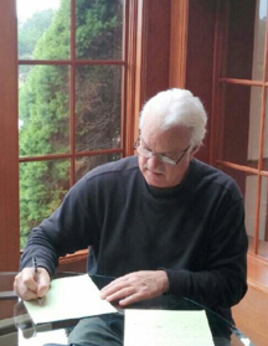
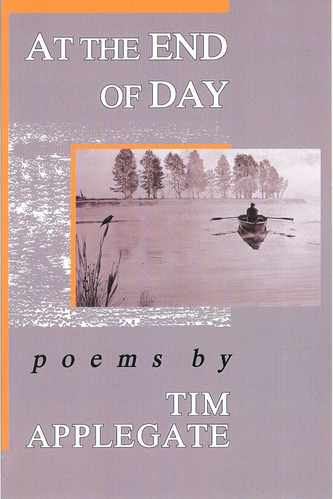
Tim Applegate's poems and essays have appeared in the The Florida Review, The South Dakota Review, The Briar Cliff Review, Lake Effect, and many other journals.  He is the author of At the End of Day, published in 2007 by Traprock Books.  He lives outside of Gaston, a small town in the the Willamette Valley of Western Oregon.


Click the book cover to buy At the End of Day.


BLUE IRIS


On a small white canvas

an artist is sketching

a Japanese flower


which seems, at first glance,

an abstraction, the

idea of a flower

and not the thing itself.


Then you notice

how the brush

imagines the petal, how

ink roots the stem.


And now the canvas

is a page, the page

a white field

stitched in the middle

to Shushiki's haiku


                                Dead my old fine hopes

                                and dry my dreaming but still . . .

                                iris, blue each spring


Published by Laughing Dog.


BLANCHE, PEGGY, PAIGE


At sixty, Franky’s not sure how long

he can keep this up. Laying carpet. Pounding

nails. Finishing this room addition

for the Lake Oswego socialite who instructs him

not to park his truck in her driveway

because “it looks like it might leak”.

He parks on the street.


Not sure how long, because after

a lifetime of such work the body

starts to give out, a leaky engine, while the mind,

once so focused, strays, recalling with an ache

the trout streams of his youth, the elk

in the mountains, the baseball games

down at old Multnomah Stadium.


And the women, yes, always the women. Their

lovely names on Franky’s chapped

lips – Blanche, Peggy, Paige – as he

clinches the last nail, gathers up

his tools, and limps back to his pickup

in the dying light of day.


Published in Windfall.


THE FRAMING CREW


for Clemens Starck  


For half an hour, nobody says a word; instead we ride that

necessary silence -- still bleary from last night's bourbon --

through the same patchy farmland we've been riding through

all our live: bayonets of spring corn spearing the loose soil,

endless rows of soybeans on the margins of the one-silo towns,

a chorus line of poplars flinging the capes of their shadows

across the curve of a country road.


Finally outside Martinsville the new subdivision

looms into view -- the bare beams and rafters

the bones of some mastodon suspended in

thin air -- and by midmorning the truck is unloaded

and the rural calm shattered by the steady whine of our saws.


In a hundred years, no one will remember

a moment of this.  Not Sam-bam the drywall man, dead

within a year of cancer.  Not old George Dobson, still painting

baseboards on his seventy-three year old knees.  Not Jimmy, our foreman,

who is having an affair with the unhappy wife of the rich builder

we all work for.  Not Charles, cement finisher and frustrated artist,

who now scrawls his initials into concrete slabs.


In a hundred years, no one will remember a word, or gesture,

or a moment of this, though perhaps with good fortune, in this room

we're now framing, a young couple will make love, slowly

and with care, aftward opening the windows to lie

in the cool evening, to share a silence broken only

by the distant whisper of a river, by a sigh of wind in the trees.


Published by The Florida Review.     



Writer's Tip:  For what it's worth, my only advice to an aspiring poet would be this.

Travel, fall in love, grow vegetables, climb a mountain, fish a trout stream, read the

masters . . . and then write.        


Return to The Poets table of contents.